


Key takeaways
- A lost dog can behave in many different ways. One question that all owners ask is, will they come back?
- A missing dog will have the ability to find their way home because of their strong sense of smell and impressive hearing.
- However, only a small percentage of lost pets do come back on their own. This is because they are usually found and taken to animal shelters, or their owners find them themselves.
- We explore exactly how lost dogs find their way home, expert advice for owners trying to find their dogs, and the reasons why our pups run away.
How do lost dogs find their way home?
Dogs have the ability to find their way home. However, it is unlikely your lost dog will return on their own. This isn't because of their inability but rather the likelihood of your pup being picked up and taken to the local animal shelter.
A dog's homing ability is incredibly advanced because of their strong senses. They use these to understand their location and map out the world around them.
Sense of smell
The area of a dog's brain that is dedicated to processing and analyzing smells is 40 times greater than ours (source). This, paired with other differences like the ability to wiggle each nostril independently, means dogs are far superior when it comes to smelling.
As dog owners, we know this already. Our pups are always smell-oriented. But the extent of this can be pretty shocking. If the conditions are right (minimal wind), a dog has the ability to detect a scent from 12 miles away (source).
A dog will map out its life in smells. You, as owners, and your house will be an important smell. They will recognize this as their territory and you as their friends.
For this reason, if you regularly take your dog out for walks near your home, your pup will have smelt all there is to smell! They'll use this to understand their surroundings and map out their location.
This means if your dog has run away, they will have the ability to find their way back home using this powerful sense. To help them do this, try the following:
- Take treats with you when you're out searching
- Leave their food bowl outside the house
- Leave toys, blankets, and clothes outside the house

Hearing
Unsurprisingly, a dog's hearing is far more advanced than ours! In fact, they can hear sounds four times further away than we can (source). However, it's not just about distance. Because of their ability to hear higher frequencies, they can also figure out the exact location of a sound. Pretty impressive, right?
Dogs can also recognize individual voices (source). This means calling their name is an important part of the search efforts when your dog has run away!
They can use this powerful hearing to understand their locations, much like their sense of smell. Familiar sounds will be associated with different areas in your neighborhood, helping them figure out their location.
To attract your dog back home, be sure to:
- Open up the doors and windows of your house so your dog can hear the familiar sounds from inside
- Call their name out of the window frequently
- Use your dog's favorite toy that makes a sounds near windows and open doors
They can use this powerful hearing to understand their locations, much like their sense of smell.
Will a missing dog come home?
While 93% of lost dogs are found, only 20% come home on their own (source). Our beloved pups tend to enjoy their adventures when they run away, rather than focusing on coming home.
New smells, people, and dogs mean your furry friend could be following new scents for miles before they consider heading home.
This does change with every dog. If your pup is naturally shy or timid, they may hide for a while before trying to make their way back to you.
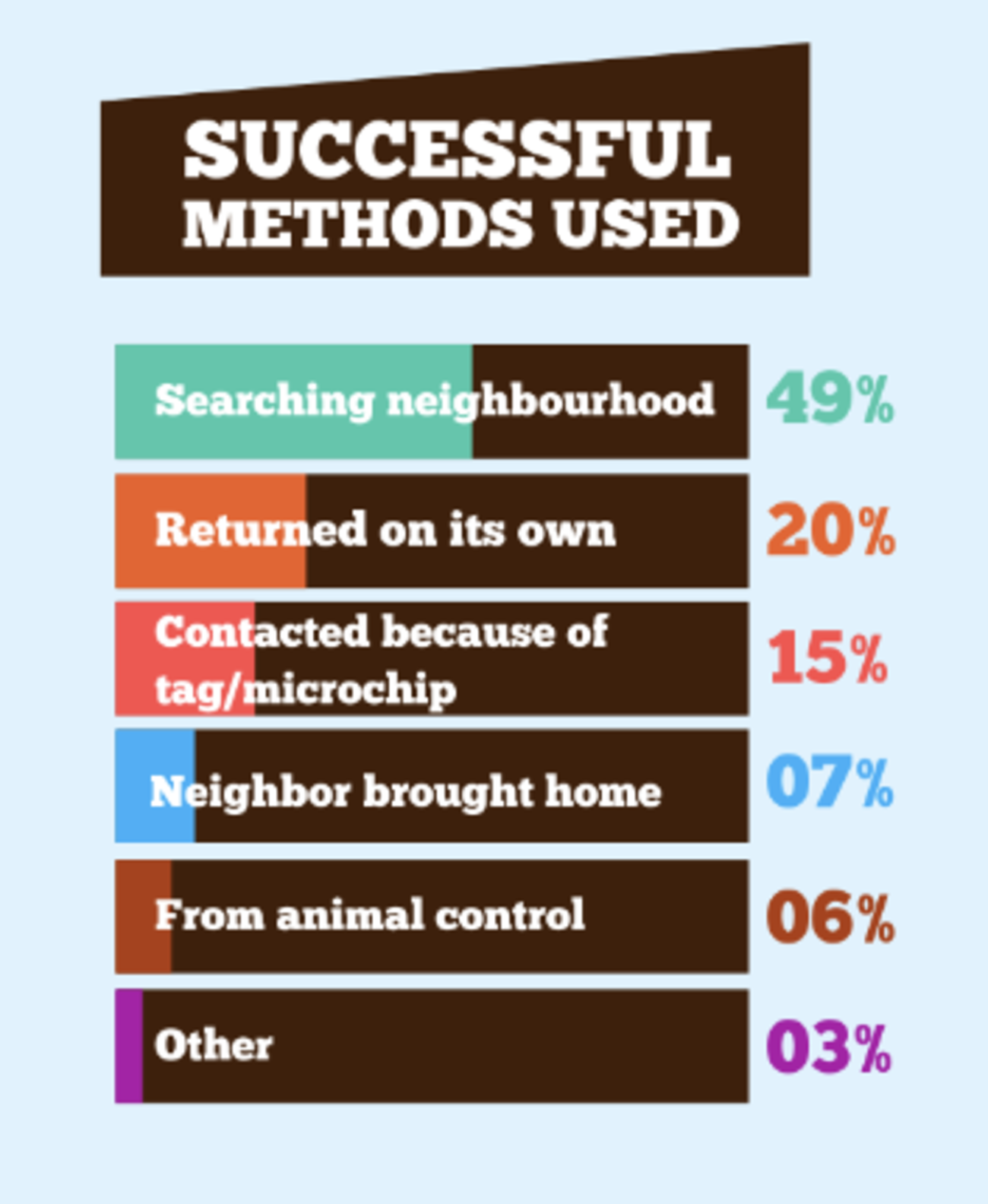
However, if you've got an excitable adventurer, then it's best you go searching yourself! Below, you can see the different search methods and how many dogs were found with each one.
If your dog hasn't come back on their own, don't panic. We're going to offer our expert advice and tips for what to do when your dog goes missing.
Thorough physical search
It's no use sitting and waiting for your dog to return. You need to get out there searching to increase your chances of finding them. As you can see, searching the neighborhood accounts for finding 50% of lost dogs.
Use the following checklist to make sure your search is as effective as possible:
- Gardens (hedges, bushes, garages, sheds, bins, garden furniture)
- Under cars
- In your neighbors' houses and gardens
- Parks
- Local shops
- Fields
- Abandoned buildings
- Farms
- Town centers
- Quiet backstreets

Contacting local animal shelters
Animal control, dog wardens, and members of the public are likely to act quickly if they see a dog wandering on their own. This usually means taking it to a local shelter if they haven't got contact details on their tag.
While this will mean your pet is safe and no longer wandering the streets, it's important you find them as soon as possible.
Unfortunately, many local shelters don't have the resources or the space to look after your dog or other found pets for a while. This means they often resort to euthanizing dogs that have not been accounted for after 3-5 days.
This isn't a lot of time, so you need to be proactive. If your dog is microchipped, then you won't need to worry too much. As long as your details are up to date, shelters will be able to contact you and let you know where your dog is.
If not, start calling all the shelters in the area and further afield to report your dog missing. Provide a detailed description, and if you can, email some photos!
Why do dogs run away?
It's the question that every pet owner asks themselves in these situations. Why did my dog run away? It's easy to blame yourself and feel guilty, but it's important to remember that the majority of the time, these things have nothing to do with us!
After all, dogs are animals that have instincts. No amount of training can teach your dog to forget their instincts.
Mating instinct
If your dog hasn't been neutered, they will have some very strong instincts to mate. This means if they pick up on the scent of another dog, especially if they are in heat, they can run miles to try and find them.
To avoid this, it's important you neuter your dog. This can also help settle your dog if they are having trouble with aggression or behavior.

Hunting instinct
We've all seen just how quickly our pups run when they see a squirrel. This is an instinct deep within them, and while it changes depending on the breed of dog, the majority of our furry friends will have some hunting instinct.
If your dog is particularly reactive when it comes to small furry animals, it's worth keeping them on a lead. If you are in a secure area, like a fenced-off field, then letting them roam free should be fine! However, if you are in a park in a city center, you risk them taking off and getting lost.
Fight or flight
A dog's fight or flight instinct can be triggered when they feel frightened or uncomfortable. This can be because of:
- Loud noises
- Unexpected visitors
- Confrontations with other animals
- Being left alone
- Visits to the vet
Their response to distress can be to run away. To try and minimize this risk, make a safe space within your house where they can retreat to to find comfort. This can be a dog bed in your bedroom, a blanket under a bed, or a setup in any room they feel comfortable in.

Curiosity
Our pups are endlessly curious. This is partly due to their neophilia, which means they are attracted to new smells (source). This can take them on adventures near and far, and it can be difficult to stop.
Training your dog can help take back a bit of control. A dog whistle or a specific sound may be enough to stop them from exploring if they are trained from a young age.
FAQs
- Report them missing to local shelters and your microchip company
- Start a thorough physical search using dog treats and calling your dog's name
- Take steps to attract them back home[[/faq-answer]]
Final thoughts
Don't give up hope of finding your lost pets. It can be an incredibly distressing time, especially when you feel like you've done all you can. Use our complete guide to finding a lost dog to make sure no stone is left unturned.
You can also start a PetRadar search to increase your chances of being reunited with your pup. We'll reach over 4,000 of your neighbors and spread the message, helping you manage all of the reported sightings in your personal dashboard.
If we can help you in any other way, don't hesitate to reach out. We've already reunited {{petsFoundBack}}, so you're in good hands!